
Special 301 Report expresses concern over weak IPR laws, to conduct reviews.

Indians in countries like the United States, China, Australia, Japan, Singapore, Egypt, Israel and South Africa celebrated the day with hoisting of the national flag and singing of patriotic songs.

The government must justify why we need to buy foreign reactors when we have developed up to 700 MWe unit-size pressurised heavy water reactors, a design which can be easily extended to 900 to 1000 MWe unit size. Why can't the 'Make in India' philosophy apply to indigenous nuclear reactors, more than 18 of which have been designed, built, and being operated by Indian engineers, asks Dr A Gopalakrishnan.

Civil Aviation Minister Ajit Singh has said that India is a land of emerging opportunities and the aviation scenario in the country is fast changing and poised for breaking boundaries and scaling new heights.

'Xi Jinping got a dose of Modi's medicine inside the tent where he was being hosted on the banks of the Sabarmati river.' 'Modi reportedly told him, looking deep into his eyes: "This was not expected of your country. Can you tell me when the troops are withdrawing?".'

The target of $500 billion in bilateral trade by 2020 is doable, feels Anand Sharma.


'We have a common way of looking at the world, a common way of thinking, and a common set of values that predispose us to be partners. And our interests overlap greatly,' Dr Ashton B Carter, America's next defence secretary, told Aziz Haniffa/Rediff.com in an exclusive interview.

Moving ahead with their new mantra -- Chalein Saath Saath: Forward Together We Go -- Prime Minister Narendra Modi and United States President Barack Obama on Tuesday vowed to deepen cooperation in every sector for the benefit of global stability and people's livelihoods over the next ten years.

India must present its demands of America confidently, instead of fearing that its pocket will somehow be picked, says Ajai Shukla.

'Those who have seen the functioning of the Modi government in Gujarat know that the issues related to Hindutva and issues of economy and growth function simultaneously.' 'Modi's politics are based on the understanding of the middle-class consumer society which is in pursuit of material aspirations.' Sheela Bhatt/Rediff.com reveals the Modi government's economic and political plans for the year ahead.

'India is no longer the India of the '70s and the '80s.' 'It's a large country with the fastest growing economy.' 'In working with India, you just can't go and humiliate the nation publicly.' USIBC President Mukesh Aghi tells Aziz Haniffa/Rediff.com about how he advises American companies to do business with India, what he thinks of Modi's government and the way forward for the India-US relationship.
The second and final part of former cabinet secretary Naresh Chandra's interview to Sheela Bhatt.

'We don't have to be the world's policeman. We don't have to impose our values. But we need to lead and when we pull back as we've done, you begin to see exactly what happens -- the voids are filled by threats of terror that countries have to suffer with, including India.'
Stephen P Cohen pays tribute to strategic expert B Raman, who passed away recently.

US Ambassador Richard Verma's tips to the Indian states.

A sensational interview on India-China ties, with the man most qualified to answer.
'We don't want confrontation; we are trying to build a cooperative relationship in which both sides have stakes in producing an improving climate of relations and responsible behaviour.' What does Shiv Shankar Menon, one of India's most brilliant diplomats and the former National Security Advisor, think of the Modi visit to the US, the Chinese stand-off in Ladakh and the situation on the LoC?

'Whether it's investments in Kashmir, building naval facilities, or selling top-of-the-range military equipment, Pakistan could well benefit more under Xi's watch.' 'Do Chinese concerns about the 'Islamisation' of Pakistan give it pause about how quickly to move forward with security and economic projects? At the moment the indication is quite the opposite: China is doubling down on its support to Pakistan, partly because of its fears about where the country is headed.'

Can Modi and Obama forge a common outlook on international terrorism?

'India-US defence pacts are seen by many analysts as a subtle move to jointly contain China's growing militarism, especially in the strategic Indian Ocean Region.'

'Modi's investment in the relationship with Washington is the biggest deliverable of this visit. He means business and that's fantastic!'

Praising the US for turning barriers into bridges of partnership, he said that America had stood with India when the support was needed the most, like when terrorists attacked Mumbai in November 2008 and in other economic endeavours as well

On her last day as India's envoy to the United States, Ambassador Nirupama Rao was felicitated by the Barck Obama administration at the State Department on Monday, with US Secretary of State John F Kerry thanking her for her service toward furthering the strategic partnership between the two nations.
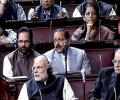
It is not in the Lok Sabha, where the BJP has a clear majority, but the Rajya Sabha that the Opposition has ganged up to checkmate Prime Minister Narendra Modi's ambitious plans.

The joint statement issued after Prime Minister Narendra Modi and President Barack Obama's first-ever summit is high on intent and ambition. Notably missing from the statement is India's refusal to be America's partner in its war against ISIS.
'Under Narendra Modi's leadership, we will be able to regain our rightful place in the community of nations,' veteran diplomat Hardeep Singh Puri, who joined the BJP on January 2, tells Rediff.com's Sheela Bhatt.
US Assistant Secretary of State for South and Central Asia Nisha Desai Biswal believes the India-US nuclear deal is not in limbo and it is for India and Pakistan to set the pace for conversations to resolve their issues. Rediff.com's Aziz Haniffa reports from Washington, DC.

'What gives hope is that Modi's own leadership is vitally linked to his capacity to deliver on the economic front. Indeed, if he succeeds, India's foreign policies will have changed beyond recognition,' feels Ambassador M K Bhadrakumar.

'Diplomatic engagement will continue even as India keeps all its options open with respect to discretely targeting the Pakistani military and its terrorist proxies.'

'The US wants Modi to succeed because we want India to succeed. For our part, when India thinks of its partners in the world, we want it to think of the US first. That means positioning our country as the preferred provider of the key inputs that can help to propel India's rise.' 'The meeting between Modi and Obama is, and must be, an opportunity for true strategic dialogue -- not a scripted exchange of talking points, but an open discussion of the big questions. What kind of world do we want to live in? What are our true priorities? And most importantly, why does this partnership still matter?'

Hindu-American Congresswon Tulsi Gabbard coasts to a rollicking re-election victory in in Hawaii's 2nd District

Since 2004 the Congress has hung onto power in a situation in which it was on track to be out of power. In each case, it effectively gamed the system through Constitutional coups, argues columnist Rajeev Srinivasan.

'Prime Minister Manmohan Singh refused to allow us to project his real personality to let the people of India know exactly what he really was. He was always shying away from greater public exposure. Since the last two years we have seen enormous criticism, ridiculing the prime minister. He has been made into an object of jokes. It certainly hurts. I think this man deserves lots of good reviews... His contribution to social policy, his contribution to the economy, his contribution to coalition management, his contribution to foreign policy.' Dr Sanjaya Baru, Dr Singh's former media advisor who is in the eye of a storm over his book on the prime minister UPA speaks to Rediff.com's Sheela Bhatt.
